
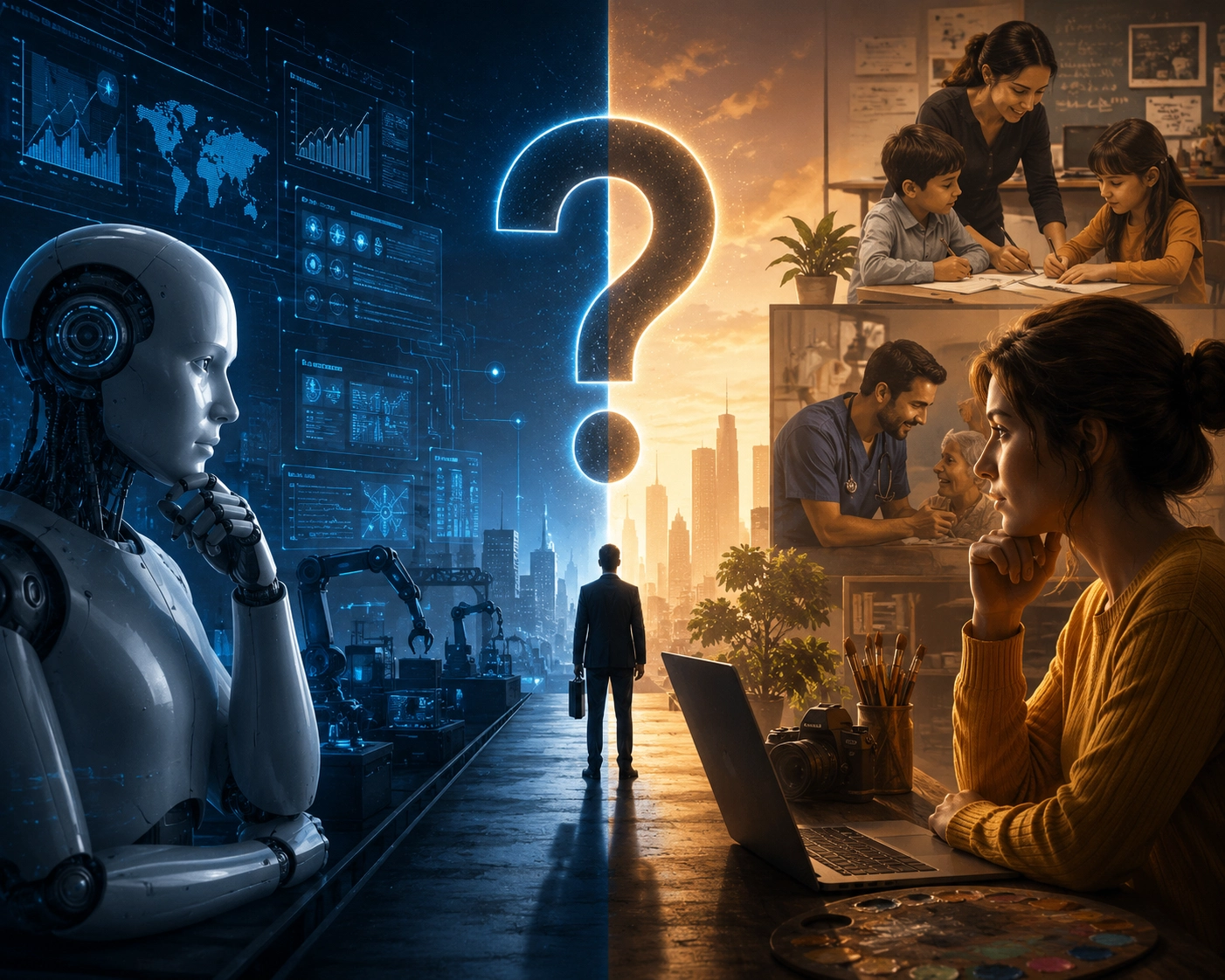
Artificial Intelligence (AI) is transforming the way businesses operate, changing industries, and reshaping the global workforce. From customer service chatbots to self-driving technology and advanced data analysis, AI has become a powerful tool that improves efficiency and productivity.
As AI adoption continues to grow, one question is being asked more than ever: Can AI replace human jobs? While AI can automate many repetitive tasks, experts generally believe it is more likely to change the nature of work than completely replace human workers. The future workplace is expected to combine human creativity with AI-powered technology, creating new opportunities alongside new challenges.
The Rise of Artificial Intelligence. Can AI Replace Human Jobs?
Artificial Intelligence has evolved rapidly over the past decade. Improvements in machine learning, natural language processing, robotics, and cloud computing have enabled AI systems to perform tasks that once required human intelligence.
Today, AI is used across numerous industries, including:
- Healthcare
- Banking and finance
- Manufacturing
- Retail
- Education
- Transportation
- Agriculture
- Marketing
- Customer service
- Software development
Businesses are adopting AI to reduce costs, improve accuracy, and make faster decisions based on data.
Which Jobs Are Most at Risk?
AI is particularly effective at handling repetitive, predictable, and rule-based tasks.
Jobs that may experience significant automation include:
- Data entry clerks
- Telemarketing
- Basic customer support
- Manufacturing assembly work
- Bookkeeping
- Cashiers
- Administrative assistants
- Warehouse operations
- Basic translation
- Scheduling and appointment management
Automation can increase productivity, but it may also reduce demand for certain routine roles.
Jobs AI Is Less Likely to Replace
Many careers rely on skills that AI cannot easily replicate.
These include:
- Doctors and nurses
- Teachers
- Psychologists
- Social workers
- Lawyers handling complex cases
- Scientists
- Engineers
- Artists and designers
- Entrepreneurs
- Skilled trades
These professions require creativity, emotional intelligence, ethical judgment, leadership, and complex decision-making—qualities where humans continue to have significant advantages.
AI Creates New Job Opportunities
Although AI may automate some tasks, it is also creating entirely new careers.
Growing AI-related roles include:
- AI engineers
- Machine learning specialists
- Data scientists
- AI ethics consultants
- Prompt engineers
- Robotics technicians
- Cybersecurity analysts
- Cloud architects
- Automation specialists
- AI product managers
As organizations adopt AI, demand for professionals who can develop, manage, and govern these systems is expected to increase.
Human-AI Collaboration
Rather than replacing workers completely, AI is increasingly being used to assist them.
Examples include:
- Doctors using AI to analyze medical images.
- Lawyers using AI for legal research.
- Journalists using AI to summarize information.
- Developers using AI to generate code.
- Designers using AI to create visual concepts.
- Teachers using AI to personalize learning materials.
In these cases, AI improves efficiency while humans provide oversight, creativity, and critical thinking.
Challenges of AI Adoption
The rapid growth of AI also presents several challenges.
These include:
- Job displacement
- Privacy concerns
- Algorithmic bias
- Cybersecurity risks
- Ethical decision-making
- Workforce retraining
- Regulatory uncertainty
Governments, businesses, and educational institutions are working to develop policies that encourage responsible AI adoption while supporting workers affected by automation.
Skills That Will Matter in the AI Era
To remain competitive in an AI-driven economy, workers should focus on developing skills that complement technology.
Important future skills include:
- Critical thinking
- Creativity
- Communication
- Emotional intelligence
- Leadership
- Problem-solving
- Digital literacy
- AI literacy
- Adaptability
- Continuous learning
People who combine technical knowledge with human-centered skills are likely to remain in high demand.
Preparing for the Future of Work
Individuals and businesses can prepare for AI by embracing lifelong learning and investing in new skills.
Practical steps include:
- Learning digital tools
- Understanding AI fundamentals
- Taking online courses
- Building technical expertise
- Improving soft skills
- Staying informed about industry trends
- Gaining experience with AI-powered software
Continuous learning will become increasingly important as technology continues to evolve.
Can AI Replace Human Jobs Completely?
Most experts believe the answer is no.
AI excels at processing data, recognizing patterns, and automating repetitive tasks. However, it lacks genuine human qualities such as empathy, moral judgment, intuition, and original creativity.
Instead of replacing people entirely, AI is expected to transform how work is performed. Many jobs will evolve, with employees using AI as a productivity tool rather than competing directly against it.
The organizations that successfully combine human talent with artificial intelligence are likely to achieve the greatest long-term success. #Can AI Replace Human Jobs
Final Thoughts
The question “Can AI replace human jobs?” does not have a simple yes-or-no answer. Artificial intelligence will undoubtedly automate some roles while creating new opportunities in emerging industries. The future workforce will likely depend on collaboration between humans and intelligent machines rather than one replacing the other.
For workers, the best strategy is to embrace change, develop in-demand skills, and view AI as a tool that can enhance productivity rather than simply a threat to employment. Those who continue learning and adapting will be better positioned to succeed in the evolving world of work.
Learn more about Artificial Intelligence from IBM:
https://www.ibm.com/think/topics/artificial-intelligence
Stay informed— see more news on todaynewspakistan.com website.