
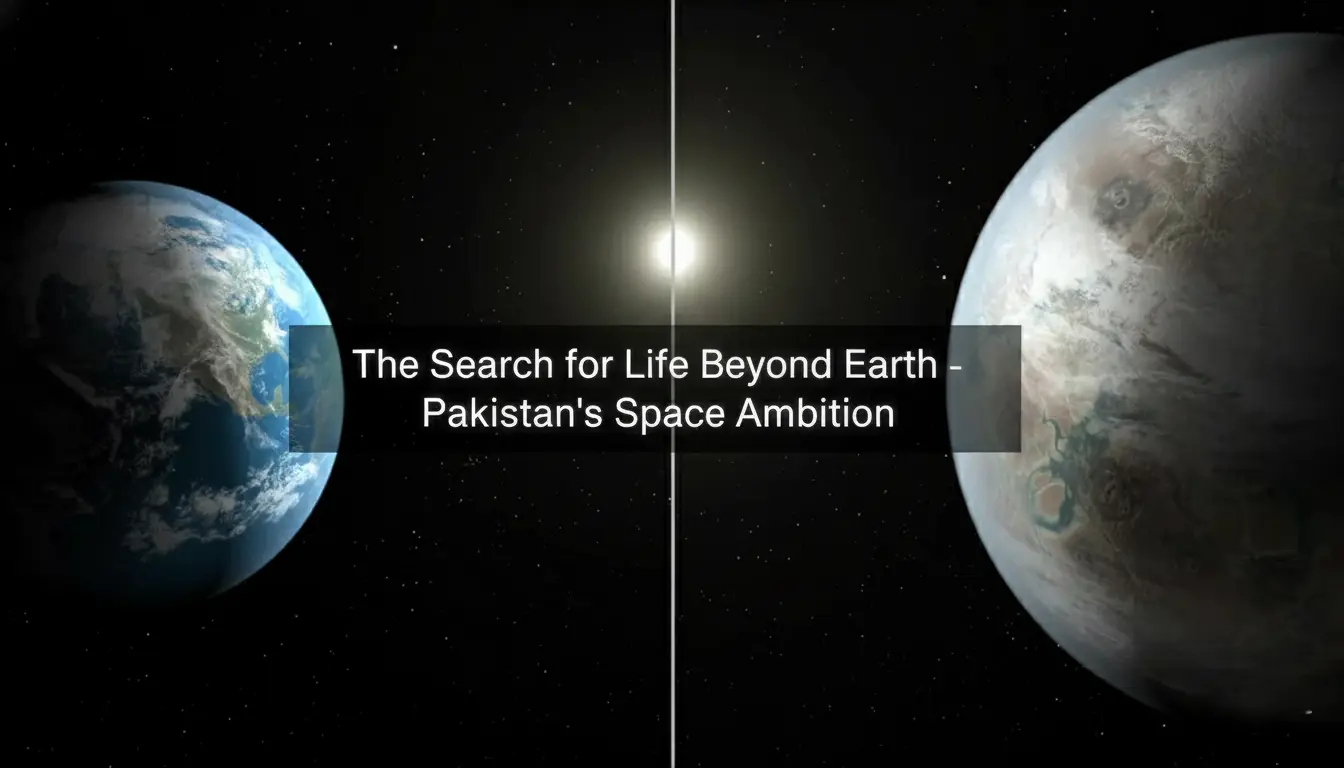
People have always looked up at the night sky in awe and asked the age-old question: Are we alone in the universe? One of the most exciting and important things science does is look for life beyond Earth. Scientists use astronomy, biology, and technology to try to figure out the mysteries of the universe.
A Universe with Many Options – Life Beyond Earth
There are billions of stars and planets in our solar system alone. But thanks to powerful telescopes and space probes, scientists now think that there are over 100 billion galaxies in the observable universe, each of which could have a lot of planets.
Because of how big it is, it’s statistically possible that life exists somewhere else (Life Beyond Earth). Astronomers are still looking for worlds that could have liquid water, which is the most important thing for life as we know it. These worlds range from Jupiter’s icy moons to distant “super-Earths” that orbit other stars.
NASA, ESA, and the Global Space Efforts
For decades, space agencies like NASA (USA), ESA (Europe), and JAXA (Japan) have been sending spacecraft to study Mars, Venus, and other planets.
NASA’s Perseverance Rover and other recent missions have found signs of old riverbeds and organic molecules on Mars. These are strong signs that the Red Planet may have once had microbial life.
Advanced telescopes like the James Webb Space Telescope (JWST) and Kepler are scanning the skies for exoplanets—planets outside our solar system—that orbit their stars in the “habitable zone,” where temperatures could allow water to exist.
Dr. Lisa Kaltenegger, an astrobiologist at Cornell University, says, “Every discovery brings us one step closer to answering the question: Is Earth truly unique?”
Pakistan’s Growing Interest in Space Science
Students, teachers, and science lovers in Pakistan are becoming more interested in astronomy (Life Beyond Earth). Groups like SUPARCO (Space and Upper Atmosphere Research Commission) and local observatories are expanding their outreach programs to get young people interested in space exploration and STEM careers.
Amateur astronomers in Karachi, Lahore, and Islamabad often hold stargazing events and workshops to teach kids about galaxies, telescopes, and how things move in space. A few Pakistani universities have also started space science departments that offer degrees in astrophysics and satellite engineering. This makes Pakistan a part of the global scientific community that is looking beyond Earth.
Dr. Salman Tariq, a Pakistani astrophysicist who works with young people, says, “The universe makes us curious, and curiosity makes us move forward.”
The Future of Discovery
As new technologies come out, like AI-powered telescopes and interstellar probes, people will be able to find signs of life beyond Earth even better. Every mission, discovery, and picture from deep space makes us more aware that we might not be alone in the stars.
Pakistan’s growing role in space education and research means that its young people will be part of this global search, which isn’t just about the stars but also about the future.
📢 Stay informed — see more news on todaynewspakistan.com website.